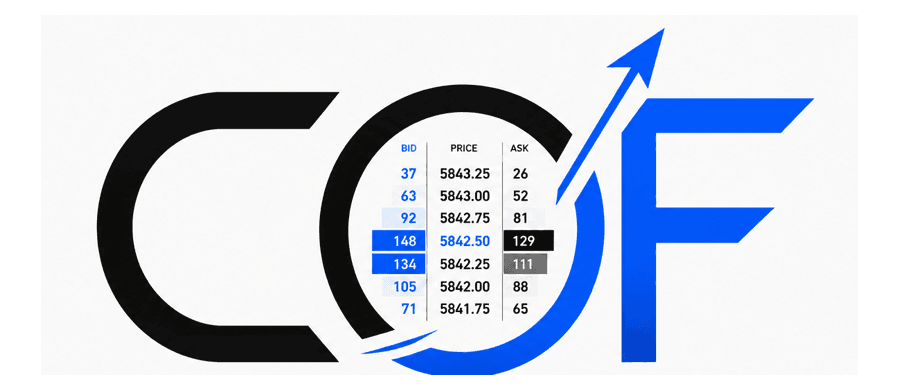
DOM (Depth of Market) — Pro Order Book Reading CME
The DOM displays the available liquidity at each price level. Pro guide: order book layers, spoofing detection, stacked bids, pulled orders, and imbalance ratio. Advanced order flow level on ATAS.
Erwin
Founder cofiatrading
The DOM is what a market maker sees. It's the tool that shows, in real-time, how many contracts are resting at each price level above and below the current price.
For a trader who only reads candles, the DOM is invisible. For a pro trader, it's one of the three core tools alongside the tape and the footprint. Without the DOM, you're trading liquidity blind.
This article breaks down the DOM level by level: its anatomy, how to detect spoofing (manipulation), how to read a stacked bids wall, and how to quantify directional pressure via the imbalance ratio.
Free Volume Profile Cheatsheet PDF →
Anatomy of the DOM, Order Book Layers
The DOM (Depth of Market) shows the resting liquidity on each side of the market. Bid side (resting buyers, below the price). Ask side (resting sellers, above the price). In the middle, the spread = difference between best bid and best ask.
DOM (Depth of Market) — 5 niveaux ask + 5 niveaux bid
Le carnet d'ordres montre la liquidité en attente à chaque prix. Couches épaisses = niveaux clés.
Schéma — DOM = photo statique de l'intention. Le tape = exécution réelle. Lis les deux ensemble.
The further you get from the current price, the deeper the levels you're looking at. ATAS typically displays 5 to 10 levels on each side. A pro trader looks at a minimum of 5 levels to get a view of the available liquidity.
Basic reading:
- Thick layers = levels where many contracts are resting. Likely important psychological or technical levels.
- Thin layers = low liquidity. Prices can slice through these zones quickly (DOM equivalent of an LVN).
- Bid/ask asymmetry = directional pressure. Bids larger than asks = nascent bullish pressure.
Important to understand: the DOM is static at time T. It changes every millisecond. It is the displayed intention of the market, not the actual execution. The tape gives the execution. You read both together.
Spoofing, the Manipulation You Must Know How to Detect
Spoofing is the art of placing a massive fake order to mislead the market, then pulling it before it gets executed. It's illegal (Dodd-Frank, MAR Europe), but without real-time monitoring, it regularly goes unnoticed.
Pattern de spoofing — manipulation DOM
Le spoofing pose un faux ordre énorme pour induire en erreur. L'ordre est retiré avant exécution. Illégal mais fréquent.
Détection : ordre énorme posé puis retiré sans exécution = signature spoof.
Si tu vois ça, ne suis PAS la direction du faux ordre. C'est un piège.
Schéma — le spoofing est illégal (Dodd-Frank, MAR). Mais sans surveillance temps-réel, il passe.
The classic spoof pattern: a trader places 1,800 contracts on the bid at a level just below the current price. Other traders see this "massive support" and position themselves as buyers (they buy the ask, pushing the price upward). When the price rises, the spoofer pulls their bid before it gets executed, and pockets the gains from the upward move they triggered.
How to detect it:
- Abnormal size: an order 5 to 10× larger than the DOM average = suspect.
- Short lifespan: typically 2–8 seconds. Real liquidity holds for minutes.
- Pulled before execution: if the price approaches and the order evaporates = signature.
- Suspect cluster: multiple consecutive spoofs across different levels = same algo scalping.
Practical rule: NEVER follow the direction of a massive fake order. If you see a 1,800 bid at 18,510, don't rush to buy on the pretext that "support is solid". Wait to see if the order actually absorbs hits.
Stacked Bids, the Buy-Side Liquidity Wall
Opposite to the spoof, we have the stacked bids pattern: multiple consecutive levels of significant bids placed together. This time the liquidity is real and signals a strong support zone.
Stacked bids — empilement de gros bids consécutifs
4 niveaux de bids consécutifs > 1 400 ctr. Forte conviction acheteuse. Niveau 18 506–18 509 = zone de support.
Schéma — un mur de liquidité réel doit absorber les attaques sans se retirer.
In the example above, 4 consecutive levels between 18,506 and 18,509 each display 1,480 to 1,820 contracts on the bid. This is a zone defended by an institutional buyer (or multiple) looking to absorb all selling pressure within this range.
How to exploit this information:
- Long on retest: if the price drops to test this zone, wait for a rejection wick or a bounce signal before entering. Stop below the last stacked level.
- Confluence with VAL: if the stacked zone matches the VAL or an HVN, the setup becomes high probability.
- Check resistance: a true liquidity wall must absorb hits without pulling away. Monitor the tape to confirm bids hold when attacked.
The trap to avoid: confusing stacked bids with spoofing. The difference lies in the reaction when the price approaches: the spoof pulls, the stacked holds.
Pulled Orders, Phantom Liquidity
A pulled order is a visible order that disappears before execution. On 1 order, it happens and it's normal (the trader changed their mind). On 5 consecutive orders at the same level, it's a signature of manipulation.
Ordres retirés — timeline d'une liquidité fantôme
Un gros ordre apparaît, prend des hits puis disparaît. Sur 1 850 ctr affichés, seuls 320 sont vraiment passés.
Ratio exécution : 320/1 850 = 17%. C'est un spoof à 83% pulled.
Vraie liquidité doit avoir un ratio ≥ 60–70% si attaquée. Sinon : suspecte.
Schéma — track le delta entre visible et exec. Trop d'écart = manip.
The typical timeline: a large order appears at T+0, the market moves toward it, hits start coming in, but the order is pulled before absorbing the majority. Execution / visible ratio = 17% in the example. A real order would hold at 60–70% minimum if attacked.
Metric to track: the fill ratio per level. If you see a level with many displayed orders but little execution, it's phantom liquidity. Avoid it for your setups.
ATAS allows you to track the DOM history (DOM Recorder) to reconstruct this analysis a posteriori. It's a key tool for identifying recurring manipulative algos at certain levels.
DOM Imbalance Ratio, Quantifying Instantaneous Pressure
Beyond level-by-level analysis, you can quantify the overall directional pressure of the DOM with a simple ratio: total sum of bids divided by total sum of asks (over N levels).
Ratio DOM imbalance — proxy de pression instantanée
Compare la somme totale bid vs ask sur N niveaux. Ratio ≥ 2× = pression directionnelle nette.
Schéma — DOM imbalance est instantané. Combine avec tape pour confirmer la conversion en mouvement réel.
Here is how I read this ratio:
- Ratio < 1.5×: equilibrium. No clear directional signal. Market in consolidation.
- Ratio 1.5–2.5×: moderate bias. Nascent pressure but not yet convincing. Monitor it.
- Ratio ≥ 2.5×: strong signal. The pressure is clear. If ratio > 2.5× on the bid side, the market wants to go up.
Practical case: a bid/ask ratio of 3.2× for 30 seconds signals that a serious buyer is accumulating. Combined with a volume profile at the VAL and a tape showing aggressive buy bursts, you have the 3 pillars of a long setup.
Limit to know: the DOM ratio is instantaneous. It can flip in 2 seconds if a large order appears or disappears. Relying on the ratio alone = mistake. Combine with tape and footprint to confirm conversion into real movement.
How to Configure ATAS for Pro DOM Trading
A few essential settings to exploit the DOM on ATAS:
- Center the DOM on the current price: auto-center option so you don't lose focus when the price moves.
- Display 10 levels per side: more depth = better reading of the liquidity wall.
- DOM Recorder: paid option but essential to reconstruct history and detect spoof patterns a posteriori.
- Volume by Price (VBP): overlay the volume profile on the DOM to visualize confluence.
- Order book heatmap: ATAS offers this mode which color-codes the intensity of levels. Very useful for spotting walls.
To get started with ATAS and its advanced DOM:

Footprint & volume profile
How We Integrate the DOM at cofiatrading
The DOM is heavy to monitor manually (it moves constantly). We therefore have agents that parse the DOM in real-time and alert on:
- Detected spoofs: orders ≥ 5× the average that pull in less than 8 seconds.
- Stacked walls: 3+ consecutive levels with liquidity ≥ 2× the baseline.
- Extreme imbalance ratio: bid/ask ratio exceeding ×3 over a 30s window.
These signals are cross-referenced with the footprint and the tape before being pushed to the VIP channel. We never give a standalone DOM signal — always in confluence with at least one other source.
Key Takeaways
- The DOM = resting liquidity at each price level. Static at time T, but constantly evolving.
- Spoofing = massive fake order pulled before execution. Illegal, frequent. Never follow the direction of the fake.
- Stacked bids = real liquidity walls. Strong support zone. Trade long on retest, stop below the wall.
- Pulled orders = phantom liquidity. Fill ratio < 50% = sign of manipulation. Avoid.
- Imbalance ratio = sum of bids / sum of asks over N levels. Ratio ≥ 2.5× = strong directional signal.
- The DOM is never read alone: always in combination with the tape and the footprint.
Going Further
- Pro Tape Reading and Time & Sales, the raw reading of transactions.
- How to Read an ATAS Order Flow Footprint, the footprint chart as a complement.
- Pro Iceberg Orders Detection, the DOM counterpart of icebergs.
- Liquidity Pools and Stop Hunts in Order Flow, understanding liquidity hunts.
- See the 8 Proprietary Strategies or Join the VIP Club to receive filtered DOM + footprint signals.
Disclaimer, cofiatrading publishes educational and analytical content. Nothing written here constitutes investment advice as defined by the Spain/EU CNMV/ESMA canon. Trading leveraged instruments carries a risk of capital loss. Retail loss rate on CFDs in Europe: 74-89% depending on the broker. Past performance does not predict future performance.